
First step into freelancing: Imagine spending weeks learning a skill, watching tutorials, taking notes, practicing small projects, and then reaching the moment when you ask yourself, “Now what?” That is where many beginners get stuck. Learning feels comfortable because there is always another video, another course, or another technique to discover, but earning requires you to step outside that comfort zone and put your ability in front of real people.
Your first step into freelancing is not simply creating an account on a freelance marketplace; it is the moment you decide that your developing skill can solve a real problem for someone else. In 2026, that decision can be especially meaningful because the freelance market is changing alongside artificial intelligence, remote work, and skills-based hiring. Upwork’s 2026 Future Workforce Index reports that skilled freelancing increased from 28% of skilled knowledge workers in 2025 to 38% in 2026, while 58% of full-time employees surveyed said they were considering freelancing.
Upwork The opportunity is real, but so is the competition, which means beginners need more than enthusiasm. You need a practical roadmap that takes you from learning a skill to presenting it professionally, finding suitable clients, completing your first project, collecting proof of your ability, and gradually increasing your value. This guide is designed to make that journey easier by breaking freelancing into manageable steps rather than treating it like a mysterious online shortcut to instant income.
Why Freelancing Is Worth Considering in 2026
It’s not hard to see why freelance work is so appealing.. Instead of depending entirely on one employer, a freelancer can build relationships with multiple clients and offer a specific service wherever demand exists. That could mean designing social media posts, building WordPress websites, writing blog content, managing digital marketing campaigns, editing videos, developing software, providing virtual assistance, or helping businesses use AI more effectively.
The important thing is that freelancing is not one particular job; it is a way of selling your professional skills independently. Current data shows just how significant this model has become. Upwork’s 2026 research says 38% of skilled knowledge workers were freelancing, up from 28% in 2025, while its research also found that 77% of business leaders said AI was increasing their need for fractional talent with specialized skills. Upwork’s data suggests that businesses don’t always look for people who can do everything.. They often need someone who can solve one specific problem efficiently. Your first step into freelancing should therefore be viewed as the beginning of a specialization journey, not simply an attempt to make quick money online.

The Changing World of Work
Technology has changed what businesses expect from independent workers. A freelancer today may use AI for research, brainstorming, automation, analysis, design assistance, or repetitive tasks, but the valuable part is still knowing what the client actually needs and making good decisions. Upwork’s 2026 research found that freelancers performing AI-related work earned 34% more per hour than freelancers who did not incorporate AI, while more complex AI-augmented professional work showed stronger earnings growth than lower-complexity AI execution.
Upwork This is an important lesson for beginners: don’t compete with AI; learn how to work intelligently with it. If you learn digital marketing, for example, you should not stop at generating captions with an AI tool. Learn audience research, strategy, SEO, analytics, content planning, and client communication, then use AI to make your workflow faster. Your first step into freelancing becomes much stronger when your skill combines human judgment with modern tools. The goal is not to become someone who simply presses buttons; the goal is to become someone who can take a client’s problem and turn it into a useful result.
What It Really Means to Become a Freelancer
A freelancer is essentially an independent professional who provides services to clients without becoming their permanent employee. You may work with one client for a few weeks, another for several months, and eventually develop long-term relationships with several businesses. Some freelancers work part-time while studying or holding another job, while others build freelancing into their primary career. Income can vary significantly because your earnings depend on your skill, specialization, experience, pricing, client quality, workload, and ability to market yourself.
Upwork’s current 2026 guidance emphasizes that freelancer earnings can range from relatively modest beginner rates to substantially higher rates for specialized technical, strategic, and professional work. Upwork That variation is why your first step into freelancing should not be based on unrealistic promises such as “make thousands in your first week.” A healthier approach is to think in stages: first become useful, then become reliable, then become specialized, and finally become valuable enough that clients are willing to pay more for your expertise.
Freelancer vs. Traditional Employee
The biggest difference is control. An employee generally works within an organization’s structure, while a freelancer is responsible for finding opportunities, negotiating projects, managing deadlines, communicating with clients, delivering work, and handling business-related responsibilities. Working on your own terms feels great, but it demands self-discipline. Some days you may be juggling multiple projects, while other days there may be no work at all, particularly in the beginning.. Your first step into freelancing should therefore include learning basic business habits alongside your technical skill.
Keep track of deadlines, save examples of your work, respond professionally, clarify requirements before starting, and maintain realistic expectations about income. Think of yourself not only as a worker but also as the manager of a tiny one-person business. Once you understand that mindset, freelancing becomes less confusing because you realize that finding clients and delivering work are two equally important parts of the same career.
Choosing Your First Freelancing Skill
Choosing a skill can feel overwhelming because the internet constantly introduces new opportunities. One person tells you to learn graphic design, another recommends web development, someone else says copywriting is easiest, and then you see a video claiming that AI automation is the future. Instead of chasing every trend, start with three questions: What can I learnwell? What do businesses actuallyneed? What type of work can I practice consistently?
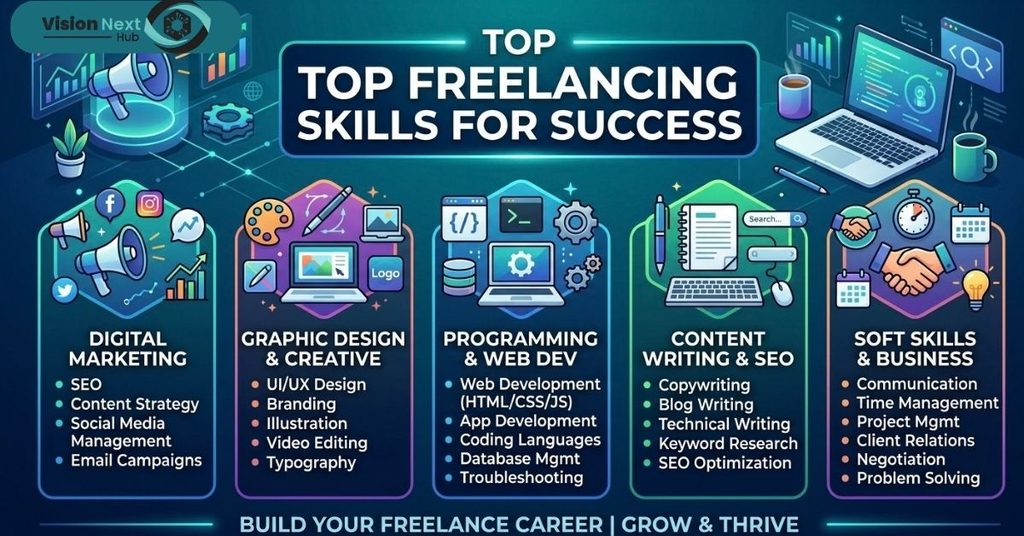
Your answers will help you choose a realistic starting point. Popular freelance categories include web design, graphic design, writing, digital marketing, programming, video editing, virtual assistance, data-related services, and AI-supported workflows. Upwork’s June 2026 hiring data listed Python, video editing, graphic design, ChatGPT, AI-generated video, data entry, virtual assistance, machine learning, web design, and Adobe Photoshop among its top AI-enabled skills. Upwork Your first step into freelancing should be connected to one skill that you can explain clearly to a potential client rather than a vague statement such as “I can do everything.”
High-Potential Skills for Beginners
For a beginner, a practical skill is usually better than an impressive-sounding skill that takes years to master before you can produce anything useful. Social media design, WordPress website setup, content writing, basic SEO, virtual assistance, presentation design, and simple digital marketing services can provide clear practice opportunities.
You can also combine related skills to create a stronger service package. For example, instead of saying “I do Canva,” you might offer “social media post design for small businesses.” Instead of saying “I know WordPress,” you might offer “WordPress setup and basic business website design.” That small change makes your service easier for clients to understand. The strongest first step into freelancing is often not learning ten different skills but learning one marketable skill deeply enough that you can confidently demonstrate what you can deliver.

Combining Skills With AI
AI should be treated as a productivity partner rather than a replacement for learning. If you know how to research, write, design, analyze, or build websites, AI can help you brainstorm, organize information, automate repetitive work, and speed up certain parts of the process. Fiverr’s 2026 research reports that 76% of freelancers surveyed use AI tools and that freelancers using AI save an average of 8.1 hours per week. It also reported strong growth in demand for AI-related services, including AI automation and prompt engineering.
Fiverr.com Your first step into freelancing can therefore include learning how to use AI responsibly while keeping your own judgment at the center of the service. A client does not really care whether you used an AI assistant to brainstorm ten headline ideas; they care whether the final headline works for their audience. That distinction is important because tools change quickly, while the ability to understand a business problem and produce a useful outcome remains valuable.
Build Your Skills Before Chasing Clients
Once you choose a skill, practice should become your daily routine. You do not need to wait until you feel “100% ready,” because that feeling may never arrive, but you should reach a level where you can complete a small project without needing someone to hold your hand through every step. Create practice projects that resemble real client work. If you want to become a social media designer, create posts for imaginary restaurants, salons, clothing stores, or property businesses.
If you want to become a WordPress freelancer, build a simple business website with a homepage, about page, services page, contact form, and responsive layout. If writing is your target skill, write sample blog posts, product descriptions, landing pages, and social captions. This practical work is one of the most important parts of your first step into freelancing because it transforms passive learning into evidence that you can actually perform the service.
Create a Portfolio Without Experience
One of the biggest beginner fears is, “How can I get a client when I have no experience?” The answer is to create your own experience through projects. You do not need to falsely claim that an imaginary company hired you. Instead, label your work honestly as a sample project or practice project and use it to demonstrate your ability. A portfolio can contain five strong examples that show different aspects of your skill rather than twenty weak pieces created just to fill space.
Explain the goal of each project, what you created, what tools you used, and what problem your work was designed to solve. Your first step into freelancing becomes easier when a potential client can see the result instead of simply reading “I am talented.” Remember, clients are often buying confidence. A clean portfolio gives them a reason to believe that you can handle their project even before you have a long list of reviews.
Choose the Right Freelancing Platform
There are many ways to find freelance clients. You can use marketplaces such as Upwork and Fiverr, approach businesses directly, network through social media, build relationships through professional communities, or attract clients through your own website. You do not need to be everywhere at once. Choose one or two channels and learn how they work.
On a marketplace, your profile, portfolio, proposals, pricing, reviews, and communication all influence your chances. Direct outreach requires stronger research because you need to identify businesses that genuinely need your service and contact them appropriately. Your first step into freelancing should be focused rather than scattered. Spending one hour improving one strong profile is usually more useful than creating five incomplete profiles and checking all of them every ten minutes.
Build a Profile That Attracts Clients
Your profile should answer a client’s most important question quickly: “How can this person help me?” Avoid writing a long biography that focuses only on your dreams, education, or desire to earn. Instead, describe the service you provide, the type of client you help, and the outcome you aim to deliver.
For example, “I design clean, engaging social media posts for small businesses” is much clearer than “I am a passionate beginner looking for opportunities.” Add relevant portfolio samples, use a professional profile picture, write naturally, and make sure your service descriptions are accurate. Your first step into freelancing should also include learning how to communicate your value without exaggerating your experience. You do not have to pretend to be an expert; you simply need to make it easy for the right client to understand what you can do.
How to Find Your First Freelance Client
Finding the first client is often harder than completing the actual project because you are entering a marketplace where other freelancers already have reviews and established reputations. That does not mean beginners have no chance. Start by looking for smaller projects that genuinely match your ability. Read the project description carefully before applying, identify what the client needs, and make your message specific to that project.
Avoid copying the same generic proposal and sending it to dozens of clients. A client who receives “Dear Sir, I can do this perfectly, please hire me” has little reason to choose you. A better first step into freelancing is to show that you understand the specific problem and can explain how you would approach it. Your first client may not be your biggest client, and that is perfectly fine. The goal is to get the first real opportunity, complete it professionally, and turn that experience into proof for the next opportunity.
Writing Proposals That Get Attention
A strong proposal is short enough to respect the client’s time but detailed enough to demonstrate understanding. Start by identifying the client’s actual requirement, then explain the relevant part of your experience or portfolio. If you have noticed something useful about their project, mention it naturally. Instead of writing a long paragraph about yourself, focus on the client’s situation.
You can finish by suggesting a simple next step, such as discussing the requirements or confirming the deliverables. Your first step into freelancing is not about writing the most complicated proposal; it is about making the client feel that a real person actually read their project. Personalization matters because clients can quickly recognize generic applications. Even if ten freelancers have similar technical skills, the freelancer who communicates clearly and demonstrates genuine understanding can stand out.
Upwork’s current guidance shows that freelance rates vary dramatically by profession and specialization, with some categories operating around lower hourly ranges and highly specialized technical or consulting services reaching $100 or more per hour. Upwork The important lesson from your first step into freelancing is that your first rate is not a permanent salary. It is an entry point. As your results improve, your pricing should evolve with your value.
Freelancing Stage Main Focus Typical Goal
Beginner Learning + practice Build useful skills
Portfolio Stage Sample projects Show proof of ability
First Client Small paid project Gain real experience
Growing Freelancer Reviews + repeat work Build consistency
Specialist Expertise + results Increase rates and client quality
Communicate Like a Professional
Technical ability may get you an opportunity, but communication can determine whether the client trusts you with future work. Confirm the requirements before beginning, ask questions when something is unclear, and never promise a deadline you cannot meet. If a problem appears, tell the client early rather than disappearing and hoping the issue solves itself.
Keep messages polite, direct, and easy to understand. Your first step into freelancing should teach you that clients are not only buying a finished file or website; they are buying reliability. Imagine two freelancers producing equally good designs. One responds clearly, confirms revisions, and delivers on time, while the other disappears for two days and sends an incomplete file. Which freelancer would you hire again? Professional behavior can become a competitive advantage even when your technical skill is still developing.
Deliver Excellent Work and Earn Repeat Business
Getting the first project is exciting, but completing it successfully is where the real career-building begins. Before delivery, check your work carefully against the original requirements. Test links, proofread text, check image quality, review formatting, and make sure the final files are organized. When appropriate, ask the client whether they are satisfied and whether anything needs adjustment within the agreed scope.
A successful first project can lead to a testimonial, referral, repeat order, or larger assignment. This is why your first step into freelancing should never be measured only by the amount of money received from the first project. The real value may be the portfolio piece, review, confidence, relationship, and experience that you gain from it. One small project can become the first brick in a much larger professional career.
Avoid Common Beginner Freelancing Mistakes
New freelancers often focus so heavily on getting hired that they ignore warning signs. They may accept every project, agree to unrealistic deadlines, work without clear requirements, make unlimited revisions, or chase clients who promise huge payments without credible details. Another common mistake is constantly switching skills. Someone learns graphic design for one week, then jumps into coding, then SEO, then drops everything for the newest AI trend. Progress becomes impossible because there is no consistent direction.
Your first step into freelancing should involve patience and boundaries. Choose a service, practice it, understand the marketplace, and improve based on real feedback. Also remember that scams exist, so never rush into suspicious arrangements simply because someone promises easy money. Protect your work, your accounts, your personal information, and your time.
Turn Your First Project Into a Career
Your first paid project should not be the finish line. Think of it as the first chapter. After completing it, analyze what went well, what took too long, what the client appreciated, and what could be improved. Add the strongest result to your portfolio, request a testimonial when appropriate, and look for patterns in the type of work you enjoy and perform well. If clients repeatedly ask for the same service, consider specializing in that area.
Specialization can make your marketing easier because you become known for solving a particular type of problem. Your first step into freelancing eventually becomes a complete system: learning, practicing, marketing, selling, delivering, collecting feedback, and improving. Upwork’s 2026 research also points toward increasing value in complex AI-augmented work, where professionals combine tools with expertise, judgment, workflow design, and business understanding. Upwork That suggests the strongest long-term strategy is not simply learning more tools, but learning how to use tools to produce better outcomes.
A Simple 30-Day Freelancing Action Plan
If the entire process feels overwhelming, make your first month simple. During the first week, choose one service and identify the exact type of client you want to help. Spend the next week creating several strong practice projects and improving your technical ability. In the third week, build your portfolio and professional profile, prepare a few customized proposal templates, and research realistic pricing.
During the fourth week, begin applying consistently, contacting suitable prospects, improving your proposals, and reviewing the response you receive. This structured first step into freelancing gives you something more valuable than motivation: a routine. You do not need to become a successful freelancer overnight. You need to complete the next useful action today, then repeat it tomorrow. Progress in freelancing often looks boring from the outside—practice, apply, communicate, deliver, improve—but those small actions eventually create momentum.
Conclusion
Going from learner to earner is not a magical transformation that happens when you open a freelance account. It happens when you take everything you have learned and begin using it to solve real problems for real people. Your first step into freelancing may feel uncomfortable because you are moving from a controlled learning environment into a competitive marketplace where clients can say yes or no.
That is normal. The goal is not to eliminate rejection or uncertainty; the goal is to become better equipped to handle them. Choose one useful skill, practice it through realistic projects, build an honest portfolio, create a clear profile, approach suitable clients, communicate professionally, and deliver work that gives people a reason to trust you again. Current industry research shows that freelancing continues to evolve rapidly, particularly as AI changes how businesses source specialized talent. Upwork So don’t wait until you feel perfectly ready. Start small, learn from every project, and let your first client become the beginning of a much bigger journey.
FAQs About Starting Freelancing
Can I start freelancing without experience?
Yes. You can start without previous paid-client experience by building practice projects and presenting them honestly as portfolio samples. Your first step into freelancing should focus on proving that you can complete a specific task rather than pretending that you already have years of professional experience. Strong samples, clear communication, and reliability can help compensate for a limited work history.
Which skill should a beginner learn first?
There is no single best skill for everyone. Choose something that matches your interests, has identifiable business demand, and allows you to create practical examples relatively quickly. Your first step into freelancing should be based on one focused service rather than trying to learn every popular online skill at the same time.
What is the most important first step into freelancing to land your first client?
There is no guaranteed timeline to get your first client, but taking a smart first step into freelancing involves focusing on a clear offer, building a solid portfolio, and consistent networking. Instead of expecting results in a specific number of days, direct your effort toward improving your skills and outreach strategy.
Should beginners work for free?
Free practice projects can be useful when you create them for your own portfolio, but repeatedly doing unpaid client work can make it difficult to build a sustainable career. A beginner can offer a smaller, clearly defined paid service at a reasonable introductory price instead. Your first step into freelancing should teach you to exchange genuine value for fair compensation.
Can freelancing become a full-time career?
Yes, freelancing can become a full-time career, although income and stability vary by person, skill, niche, market, and client base. Current Upwork research shows skilled freelancing expanding significantly, with 38% of skilled knowledge workers surveyed operating as freelancers in 2026. Upwork Your first step into freelancing is therefore not necessarily just a side project; with consistent skill development, marketing, client relationships, and financial planning, it can grow into a serious professional path.